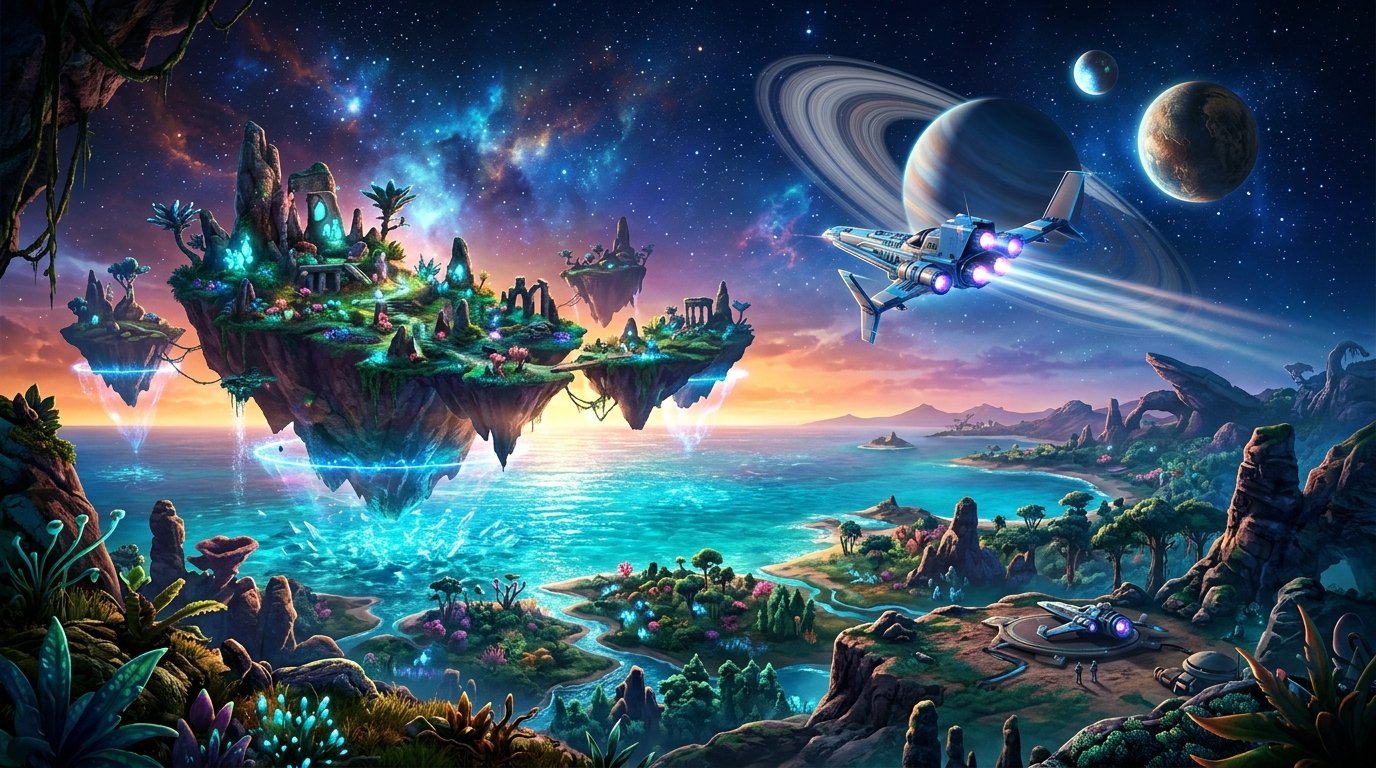
The Mathematics of Procedural Generation in No Man's Sky
No Man's Sky contains approximately 18,446,744,073,709,551,616 (18.4 quintillion) unique planets distributed across 256 distinct galaxies, beginning in the starting galaxy of Euclid. Rather than storing millions of static 3D world models on server farms—which would require billions of gigabytes of cloud storage—Hello Games developed a breakthrough deterministic procedural engine driven by a mathematical superformula and 64-bit coordinate seeds.
Every celestial body in the No Man's Sky universe is tied directly to its spatial coordinates in the galaxy. When your starship enters an uncharted star system, your local CPU and GPU evaluate mathematical functions for terrain elevation, volumetric cloud formations, ocean depth, mineral distribution, and flora and fauna taxonomy. Because the formula is deterministic, any player across PlayStation, PC, Xbox, or Nintendo Switch visiting the exact same portal coordinates will encounter identical geographical mountain ridges, cave networks, and alien life forms.
Comprehensive Biome Taxonomy & Planetary Archetypes
Planets in No Man's Sky are grouped into major ecological categories, each dictating atmospheric toxicity, thermal hazards, flora geometry, and survival hazard drain:
| Biome Archetype | Atmospheric Threat | Dominant Resources | Ideal Player Utility |
|---|---|---|---|
| Lush / Paradise | None / Mild Rain / Boiling Superstorms | Star Bulb, Paraffinium, Nitrogen | Primary Main Base, Farming, Settlement Hubs |
| Scorched / Fiery | Thermal Drain (up to 300°C) | Solanium, Phosphorus, Sulphurine | Solar array optimization, engine recharging |
| Frozen / Cryo | Hypothermia Drain (-120°C) | Frost Crystal, Dioxite, Radon | Glass crafting factories, bio-dome agriculture |
| Toxic / Caustic | Chemical Hazard (Acid Rain) | Fungal Mould, Ammonia, Nitrogen | Acid & Liquid Explosive production |
| Irradiated / Gamma | Severe Nuclear Radiation | Gamma Root, Uranium, Radon | Starship launch thruster uranium fueling |
| Exotic / Glitched | Anomalous Reality Failures | Gold, Cadmium, Collectible Boundary Glitches | Base decorations, Wonder Cataloging |
Naming Conventions & Galactic Discovery Protocol
When you are the first traveler to land on an uncharted planet and step onto its surface, the Galactic Atlas grants you permanent naming rights. To ensure your cataloged discoveries appear natural and fit the deep science-fiction lore of No Man's Sky, consider following traditional astronomical taxonomy:
- System Designation + Greek Letters: Classical star mapping designates planets according to their orbital proximity to their primary sun using Greek suffixes, such as Kepler-186f, Alpha Centauri Prime, or Sigma Scorpii Minor.
- Alien Race Influence: Systems controlled by the Korvax feature logic-oriented, cybernetic names (e.g., Echo-Convergence 09, Subroutine Matrix). The Gek prefer titles emphasizing commerce and comfort (e.g., Gek's Golden Spire, Oasis of Opulence). The warlike Vy'keen christen worlds with martial glory (e.g., Citadel of Horg, Wrath of the Ancestors).
- Planetary Modifiers: Use astronomical tags like Prime, Secundus, Major, Terminus, or Roman numerals (IV, VII) to denote a planet's place within multi-world star clusters.
Sentinel Alert Levels & Defense Protocols
Sentinels are an ancient, self-replicating robotic defense force created by the Atlas to police planetary reality. Before constructing an expensive planetary settlement or planetary mining rig, inspect the sentinel profile generated by our tool:
- Low / Tolerant: Sentinels patrol passively and will only engage if you mine minerals directly in front of their optical scanners.
- Observant / Standard: Drones scan your activity frequently. Destroying flora or fauna triggers immediate investigation.
- High Security / Aggressive: Sentinels attack on sight without warning. These planets frequently spawn high-value Gravitino Balls or Albumen Pearls.
- Corrupted Sentinels: Discovered on Dissonant planets. They drop radiant shards, inverted mirrors, and inverted salvage essential for Sentinel Interceptor starship repairs.
Star Classification & Hyperdrive Warp Drives
Navigating the galaxy requires matching your starship's warp drive technology with stellar spectral types:
- Yellow Stars (Class F & G): The most abundant systems. Accessible with basic Hyperdrive. Ideal for locating calm paradise worlds and balanced resource deposits.
- Red Stars (Class M & K): Uncharted and abandoned systems requiring a Cadmium Drive. Home to anomalous mega-fauna and pure Cadmium veins.
- Green Stars (Class E): Hostile radioactive environments requiring an Emeril Drive. Rich in Emeril and valuable biological horrors.
- Blue Stars (Class B & O): Ultra-high-mass stars requiring an Indium Drive. Feature extreme storms, rare Activated Indium for stellar profit farming, and unique exotic planet archetypes.